Showing posts sorted by date for query moodus. Sort by relevance Show all posts

Friday, June 20, 2025

Was Machon Shlomo in the 1980s a cult?

Was Machon Shlomo in the 1980s a cult? Let's look at the primary features of a cult. The four stages are deceptive recruiting, isolation, personality breakdown, and reprogramming.

Deceptive recruiting: That's Moodus. Sports and barbeques on a 22 acre resort in the hills of Connecticut. Lots of people coming and going, including rabbis and yeshiva students who are on their best behavior as they get a free vacation for the family. The atmosphere is light. Rosenberg is a distant figure on the premises. Waiters serve your meals in a spacious dining room. At the head table was Rav Schwab, the venerable leader of the Breuer's community, an elderly Jew with a distinguished bearing from Germany. Promises are made of an Ivy League yeshivah experience in the Holy City. I don't recall if this was promised then, but Machon Shlomo now claims falsely that it's graduates occupy the highest positions in finance, law, etc. and that it has a close knit community. I remember then feeling as if I had entered a highly affluent inner sanctum of some kind. It was intoxicating. Let's examine all this falsehood as we look at the next stages of a cult.

Isolation: Machon Shlomo was situated in a few small apartments located in one four story apartment building on the outskirts of Jerusalem. There were no basketball or shuffleboard courts and volleyball nets as there were in Moodus. There was no view of the forest, but rather of a Har Menuchos cemetery. There weren't rabbis and yeshiva students coming and going. The tiny staff of six was mostly off limits. 4 of them were Gemara teachers, one for the handful of second year students only as he never spoke to first year students, and three for each of the levels. You only dealt with one of them, and even then just for the shiur. Before that he prepared. After lunch (at which time the rabbis sat at a separate table) he left. Other than the one Gemara rebbe were Rosenberg and Gershenfeld. That was the staff. It was quite a contrast from Moodus. 

It's also a contrast from Ivy League schools as they have large staff  of distinguished faculty, reams of class offerings, and lovely campuses. 

Neither Rosenberg nor Gershenfeld were around very much. Rosenberg had an apartment in Jerusalem. Gershenfeld came in only in the afternoon for his Chumash shiur. Before the shiur he prepared. After the shiur, he left. For most of the day, there were no rabbis around. Even today, if you visit Machon Shlomo, as I have done numerous times, you won't find rabbis on premises.

Worse still, Rosenberg and Gershenfeld did not qualify as rabbis. Rosenberg had been an insurance salesman and before that had a one year stint as a teacher, and a two year stint as a principal of a tiny out of town yeshiva day school in the 1960s. The job no doubt was secured by his father, who was a well-known rabbi, not necessarily a scholar but one who set up institutions in America. Rosenberg was not learned. He was not articulate. He was even anti-intellectual. He once told me that there's no such thing as intellectual depth, only emotional depth. Gershenfeld was a 29 year old baal teshuvah (when the place started) who came from a highly assimilated background. When I got there, he was 35. Neither of these two who ran a so-called Litvish yeshiva were capable of giving a Gemara shiur. They had hired hands for that. Their job was to control the message, to be the only ones to introduce the students to hashkafa and halacha.  The rest of the staff had been instructed not to talk to us. One of the promises made to me was that a student gets lots of personal attention at Machon Shlomo. This was utterly false. I spoke to Gershenfeld on four brief occasions in 2 years. Brief means under a minute, and I'm not shy. I'm a person who goes right on up to teachers and talks to them. 

Also there was no Rabbi Schwab. We had nothing to do with him and never talked about him. They didn't encourage our contacting him even when we were back in America. He had been used as a lure. 

The isolation was manifested also in the location on a development site. MS was the first resident in an area that was accessible by dirt road. There was no Jewish community there. Rosenberg told me that he chose this isolated spot intentionally so that he could have full control over the students. Thus, we never went to bar mitzvahs, weddings, brisim, shalom zachars. None of that. We never met anyone who could present a perspective different than that of R and G.

The isolation occurred also in the absence of a library. There was only a small shelf of books, maybe a dozen of them. Even today there are no books in the MS beis midrash, just bare white walls. No other yeshiva is like this. Remember also that this is before the Internet. There was no going on line for a different perspective. 

We were isolated also via the persistent condemnation of all other schools for BTs. We were told again and again that they all did things the wrong way. They were bad. We had nothing to do with any of them. Students referred to those schools as the enemies. The conditioning against them made it harder to leave. Gershenfeld once told a student, "Anybody who leaves here fails in life."

We also didn't see visitors in the beis midrash other than a neighbor or two who came for Maariv.

We also never met other rabbis. Guest speakers were not allowed. We were never taken to see gadolim. 

We never went on any trips to see Israel, not even Jerusalem. We also didn't have warm get togethers, just a small party before Chanukah and before Purim. The latter was preceded with a depressing speech against bochurim getting drunk, nothing about the meaning of Purim. 

Personality breakdown: This occurred in numerous ways. Rosenberg and Gershenfeld were obsessed with teaching the boys not to be arrogant, not by example of course because those two were quite far from humble. Putdowns were regular. You don't know anything. Your accomplishments don't impress me - that sort of thing. 

Personality breakdown also occurred through control, through treating us like children. We weren't allowed to lead davening, to choose our own seat, study partner, or dorm room, to wear black hats, or to date. We might be ready in a few years. They'd tell us  when, which of course they never did. The subtext there was that we'd need to earn their approval by adopting their view on life.

We also couldn't choose what shiurim to attend because there were no choices. There were only 2 classes: Gemara pilpul and Chumash. There was no Mishnah, Gemara bikiyus, halacha, Hebrew, Nach, Machshava, or history. There was no class in mitzvos or the calendar. Let me clarify there was a twice weekly 1/2 hour long halacha shiur given by Rosenberg who knew nothing about halacha. Example question and response: What's the bracha on pizza? I don't know I don't eat pizza. His main activity was to rant about baalei teshuvah who were audacious enough to think they knew halacha or could poskin. Everything with him was a polemic. I don't count this as a halacha shiur. 

Moreover, the Gemara and Chumash classes had the function of breaking people. Gemara was not introduced. We heard nothing about its background, language, or strange style. We just opened up to page 2 and started. I was cast into the highest shiur when I didn't even know the alphabet. We studied a few pages of Gemara from morning till night. We used all kinds of commentators even though we were beginners. And it was all done in a competitive atmosphere with the snobs in the highest shiur not talking to those in the lower ones. All of this overwhelms the mind. Gemara can break you if you care about your intellect and you are overdosed with pilpul.

Chumash consisted of Gershenfeld reading the text to us. Machon Shlomo cares about the text they said even though they didn't study the language of the text which is Hebrew. His idea of adhering to the text was to read every word. It was a like a laning from a guy who didn't pronounce Hebrew very well. Most of the shiur was him reading.

This is not the way to study Chumash. It's the way to terrify people, because Chumash is terrifying with its stories of betrayal, murder, infanticide, kidnapping, rape, war, genocide, slavery, and punishment, punishment, punishment. The nation is always failing, and that's how R and G made us feel about ourselves, that we were always failing. Chumash needs commentary. You need a rebbe to study Chumash, need a guide. Without that, you learn to be terrified of God, Judaism, the world, and yourself. Even the Ramchal says that you will not learn emunah from the plain meaning of the Chumash. So essentially everything about Machon Shlomo was designed to break you, even the little Torah that they offered. 

Questions were mocked. Why do you need to know that, was a common response. You are trying to show off with that question. That's very arrogant of you to ask that.

Reprogramming:

Machon Shlomo is not only the best yeshiva for BTs but the only one. Over and over again we heard that even though the place was brand new. They acted as if they had a long-standing reputation. I can only think that R and G thought so highly of themselves that their little school with 15 students automatically achieved value through their value. 

Your task is to go out and be a high earning corporate professional while being some kind of Litvack baal habayis. You cannot get smicha. You cannot become a rabbi. You cannot become Chassidic or Modern Orthodox. Yet strangely, one guy there who was a big masmid was criticized for his plans to go to medical school after MS. 

The Machon Shlomo derech, as it was contrived, was to be a non-questioning, non-spiritual, corporate worker who looked down on everything, and saw his identity as being a Machon Shlomo guy, which means mostly to shut down the mind and hate the world. It is quite a trick making your identity a school when that school has no alumni communication or gatherings. They never contacted us after we left even if we contacted them. They taught you to fear the world and yourself and then sent you on your way back to America alone. So, yes, another lie (and cults are in the habit of lying) was that there's a tight alumni network. There was none. They never contacted us, not a single time. Another lie was that nobody who ever went to Machon Shlomo left the religion. Firstly, they have no way of knowing that because they didn't keep in touch with anybody. Secondly, it simply isn't true. Guys from my year left the religion. I have met many since then.

So there it is. All four stages of cult indoctrination. No other school for BTs operates this way. Others deceive in their recruiting, but not like this, not black and white. They might isolate you to the yeshiva world, but not within it, not to two crazy and unlearned guys and nobody else. Other schools have guest speakers and meet gadolim. Other schools were located in frum neighborhoods not on a barren hill. Other schools offer a variety of types of classes and have libraries. Other schools can do some yeshivish type control of the students, but they don't assign your seat and ban you from dating. Machon Shlomo in the 1980s was a cult. I can say much more. But I've leave it at that. Write me for more if you suffered there and are still recovering.

The place has changed some since then. Rosenberg is dead. Har Nof is now a real neighborhood. There's a tiny library, still not much. It's in a storage room, and it's a mess. But it's more than we had. There's more staff now, and from what I hear students can speak to them. However, they still have the same schedule of six pages of Gemara and Gershenfeld and his Chumash shiur. When you have the secret sauce why change? That's the attitude over there. I suppose they think that they have never made mistakes. There's nothing to change. They are in the same set of apartments, which now look old and cruddy. They still have the same no dating rule, even for Cohanim. I don't know if it qualifies as a full fledge cult anymore but it's still a very unhealthy place, in my opinion. 

Wednesday, May 31, 2023

Machon Shlomo: Deceptive Recruiting and Isolation

"Machon Shlomo was founded in 1982 with a small student body and a small staff, in an apartment building that stood at the entrance to a fledgling Jerusalem neighborhood called Har Nof. At the time, the community consisted of a dozen newly finished buildings perched atop a mountainside, flanked on either side by forest and miles of undeveloped land. The only road to the main city was a dirt path. It was this unassuming location, far from the bustle of the city and the distractions of tourism, that the yeshiva’s founder, ...., hand-picked as the site where motivated students could build themselves to achieve greatness."

Those words are from the Machon Shlomo website. They are an attempt to glamorize what was an unhealthy situation.  Har Nof is a normal community now. Back then it was a construction site. There was no bookstore, pizza shop, or falafel store. In Israel, that means it was not an actual neighborhood. We had few neighbors and had no simchas to attend, no bar mitzvahs, no weddings, no brisim, no vorts, no shalom zachars, no shiva calls. We were nearly entirely cut off from community.

Why would you situate a school for beginners in an isolated spot? How are you going to get an introduction to Jewish life in a place like that? Well, as the head of the school is quoted as saying, the purpose was to isolate the students. He admitted it. His thought was that he was the only one who knew how to handle kiruv and he was going to shield us from all the nonsense. But nobody should think like that, particularly with kiruv, because you never know what is going to inspire a BT. The website now pretends it was to shield students from distractions to their studies, but there wasn't much to study at Machon Shlomo as they had really just two classes and no library. What kind of school has no library?

Isolation empowers the leaders to control information. They picked a remote location in order to isolate the students. For the same reason, they didn't have guest speakers and didn't go on any trips, not even to hear speakers or to meet rabbis. At that time, Rav Shlomo Zalman Auerbach, Rav Ovadia Yosef, Rav Shlomo Wolbe, Rav Elyashiv, Rav Yisroel Gustman and many other greats were living nearby. We never went to see them. It wasn't even suggested to us.

That is not what you expect when you are told the school is located in Jerusalem. That is not what you expect when told that it's a school for beginners. You imagine that they are going to introduce you to Orthodox Jewish communal life and bring intellectual content into the room. 

Turns out it isn't really in Jerusalem. It was a barren development site on the outskirts of Jerusalem. Nobody tells you that at the recruitment camp in Moodus, CT. That's what you call deceptive recruiting. Here's more on that.

Machon Shlomo, Har Nof, 1982


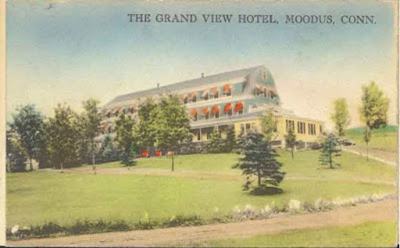
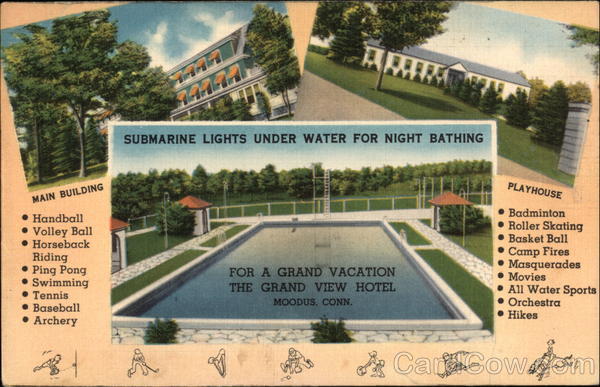
The recruitment camp was sports and catered meals on a 22 acre resort facing a forest. The resort used to be called the Grand View Hotel. Here's a postcard from the hotel:


The place, with new owners, is still used for weddings:


Fine paneled walls


Here's how a memorial article on one of the founders of Machon Shlomo and the Torah Institute at Moodus describe it:
The approach is straightforward: Create a cozy family-oriented community focused intently but calmly on the opportunity for teshuvah…. The potentially life-altering decisions played out in comfort–with a pool, basketball, and barbecues. There were canoeing excursions to the Connecticut River. The cuisine was superb. Service at mealtimes and in the rooms matched what one would expect at a hotel. In fact, the original conception was to create something striving for first class.” (Shemen Zayis Zach, p. 26)


Machon Shlomo was a few apartments with bare walls facing a cemetery. 


Moodus had all kinds of rabbis walking around as their families got free vacations. 

Yeshiva students drawn from Lakewood or Ner Israel in Baltimore or the yeshiva in Philadelphia served as tutors and peers for the summer students. They learned together, roomed together, played ball together… On Shabbos there were usually over a hundred people on hand, which further extended the size of the warm tzibbur. (Shemen Zayis Zach, p. 46-7)

Machon Shlomo had "a small staff." It was dominated by a NY businessman and his young baal teshuvah son-in-law who was 6 years out of a Christian college when the place started. Other than that, there was a Gemara shiur given by a hired hand. The Gemara rebbes were more learned, but they were told not to speak to us. So outside of the the daf, we didn't have any rabbis to speak to. The claim that there was a staff of 10 is false. It was effectively a staff of 2 because any 1 student only interacted with 2 people, each part-time. I don't know where they get 10 from. I suppose they are including tutors who came in for an hour each night, each one working with two students. 

In effect, it was a yeshiva without talmidei chochamim at least as far as hashkafa and guidance and halacha and questions about the religion were concerned. The Gemara shiur was given without any introduction to the idiom or style of the Gemar or any learning tools such as a vocabulary sheet. Some of us couldn't read Hebrew, but there was no class in Hebrew language. They just opened up to page 2 and started. This is problematic.

Question:
How can we train young boys to make a laining on a piece of gemara, to be able to read a gemara on their own, without the agmas nefesh that a lot of children and parents suffer through? 

Rabbi Avigdor Miller:
To help young boys make a good laining, I would say as follows. When someone begins to learn gemara but he’s not prepared for it, it’s like climbing a high mountain with a heavy pack on your back. You must first lighten the load. 

I would say that the first thing is to let the child learn all of Pirkei Avos. And he should be able to translate every single word. It’s not difficult, but it takes time. And he must be able to translate every word. And once he’s able to daven through Pirkei Avos without any hesitation, then give him an old mishnayis, without nekudos, and let him say Pirkei Avos. And when he learns to daven through Pirkei Avos without nekudos, now he’s ready to start Elu Metzius. Take Rabbi Lomner’s Elu Metzius. It’s a linear translation – a very easy gemara to use. Let him learn Elu Metzius. Even if he doesn’t know the meanings of the ideas – even though he doesn’t catch on to the arguments, nevertheless let him know how to translate Elu Metzius from beginning to end.

Now once he does that, then he’s ready for gemara. Yes, I guarantee you that a boy who follows this system, and he can, after a while, bentch Elu Metzius from beginning to end, he’s ready. He’ll start catching on.

Then, the problem is no longer the style of the gemara – the idiom. He knows all these things already. Now it’s the arguments of the Gemara that he’s faced with. And arguments alone he’ll be able to deal with. But without this preparation that I’m telling you about – if he’ll have to deal with the arguments plus the translation of the words and also the gemara’s style – that’s too much for him. And most boys therefore stumble on that big problem. They never had any preparation. They were never prepared properly. And I guarantee you that following this system will lead to success. 


TAPE # E-198 (November 1999)

Machon Shlomo didn't do any of that. Just open to page 2 and 'break your teeth on it.' Moreover, the environment was insanely competitive, cut-throat even. 

All day long, the students worked on a page of Gemara. They didn't study Mishnah, halacha, history, Hebrew, mitzvos, Chassidus, Musar or philosophy. Just the daf, all day long, even though they were brand new to Torah. It was painful. Essentially, they used Gemara to break the students. Other than that, there was a Chumash class that consisted mostly of the Chumash being read to us. But 90% of the day was the daf, and not in a good way.

The founder said that his goal was to break the students and rebuild them. But that's what cults do, rebuild them in the image of the cult leaders.

It's very dangerous to pound people with musar, i.e. criticism and fear of hell and not teach halacha, because if the goal of life is to eliminate your ego, how do you know when you have done it? Halacha is concrete, measurable. You know if you light a match on Shabbos. But if all you have is this vague Judaism, you'll feel that your own existence is problematic. That's Machon Shlomo. It breaks you down. 

They did this in other ways too. They ridiculed questions. As one student wrote, "However, questions are NOT part of the machon shlomo curriculum. In fact, guys are hand picked for their competitiveness and non-questioning nature. The rabbis know that the guys will hit the ground running and compete with each other to learn." 

Compare. 

Maharal:

(Baer HaGolah #6) "One should not reject something which is against one’s views… especially if it is not presented as an attack on religion but is simply an honest expression of the other person’s understanding of faith. Even if it is against one’s religious faith, he should not say, “Be quiet and shut your mouth.” Because if one silences questions there will not be a clarification of that person’s religious understanding. In fact, such a person should be encouraged to speak and fully express how he feels. If sincere questions are silenced that is indicative that the religion is weak and needs to be protected from inquiry. This attitude is the opposite of what some people think. They mistakenly think that silencing questions strengthens religious faith. In fact, however, suppressing of dissent and questions indicates a weak religion. Thus, we find with our ancestors that even if they found something in books against religion they would not simply reject it." 

Machon Shlomo:

"He taught his talmidim that most questions beginning with "Why?" (unless they are in the form "Why does Rashi or Tosafos say this?") are more likely than not to be products of the yetzer designed to deflect from a full Torah commitment. In question and answer sessions, he refused to answer as many questions as he was asked. First the questioner had to acknowledge what was really bothering him and how the information sought was relevant to his life." (article about the founder by Yonasan Rosenblum)

Does that sound like an Ivy League experience?

On top of that, they treated the students like children, assigning seats, rooms, roommates, and study partners. They forbade dating, leading davening, or wearing black hats. They environment was one of subtle and not subtle degradation. 

Personality breakdown is a trait of cults.

So is programming. And there was lots of that. As one former student said,

That was one of the truly cultish things about machon shlomo- the daily reinforcement of the idea that they had the patented "correct" view of judaism and no one, not artscroll, not the chassidim, no one really "got it" but them. 

Students heard often about the superiority of the Machon Shlomo derech. It was the right way. All other ways were wrong. But it wasn't a real derech, just a posture that everyone else was wrong. They really didn't stand for anything but deeming everyone else to be wrong.

There's much more to say, but that's an overview of it, a very unhealthy situation. 

I should say that the other schools for BTs were not like this. They were located in populated areas, had a variety of classes including introductory classes, had guest speakers, took students to see Jewish life, and tried to give a substantive introduction to Judaism. 

Now that's MS from decades ago. Har Nof is a normal neighborhood now, and the guy who gave the Questions no answers class is gone. Moodus is closed. However, the barebones program of MS remains exactly the same. Yet, the school advertises that is "the Ivy League yeshiva." From the website:


But Ivy league schools have 1000s of classes, world class faculty, beautiful campuses, all kinds of internships. MS has none of that. So how is it Ivy League? It isn't of course, so that's more false advertising.

They also claim to have graduates who are at highest echelons of their professions. "our alumni have gone on to occupy positions at the highest levels of their profession, whether it be in law, medicine, finance, education, music, engineering, public service, or rabbinics." That's ridiculous. They don't have anyone like that. Highest level of law is Supreme Court. Highest level of finance is Chairman of the Fed or Chairman of Morgan Stanley. There's nothing even remotely like that connected to Machon Shlomo. If there were, would the kitchen look like this?


All that talk is to woo you, but it's deceptive. 

MS also deceives via its outreach program called Meor. The Meor website hides that it is Orthodox and is full of photos of mixed groups of attractive young men and women all sitting together grinning ear to ear. The message: come here and find someone to date (or sleep with). Examples from Meor media


and now Machon Shlomo:


Where'd the women go?

You won't even find them on dates because MS doesn't allow dating until mid-way into the second year when you are so shut down you can't even get started. And they don't help either.

Meor has its little programs on college campuses and fancy offices which is like having them on the resort of Moodus. Then you come to the same apartment in Israel, only its now 40 years older and in bad shape. 

Machon Shlomo hasn't changed. The deceptive recruiting lives on in new forms. 

I must say, however, that despite the deception and the limitations of the place, there are guys who liked Machon Shlomo. So go figure. Some like the first year guy. Some like the second year guy. The ones who like it tend to be more conventional. "guys are hand picked for their competitiveness and non-questioning nature".

Some don't like either of them, and there are no other choices so then you are out of luck. Bottom line, it's wrong to be deceptive because you really hurt the ones for whom it isn't a match. And there have been many of those over the years. Actually you hurt even the ones who like the place because the deception plays tricks on the mind. 

Sunday, July 17, 2022

Moodus vs. Machon Shlomo


Moodus vs. Machon Shlomo


Facility

Shown below is the main building for the Torah Institute in Moodus, Connecticut. 


Originally, the Grand View Hotel, the 22 acre property and numerous buildings were acquired by the Institute which operated from about 1982 to about 2002. It served as a recruitment vehicle for Machon Shlomo, a school for baalei teshuvah men in Israel. It is one of numerous buildings on the property as we will show.

Compare this to the only building for Machon Shlomo. Actually, the school utilized only a part of this building, as numerous apartments were occupied by families that had nothing to do with the school. This picture was taken in 2022 as forty years later, Machon Shlomo is in the same location as when it was founded in 1982.


Beis Midrash

Here is the building that housed the beis midrash for the Moodus camp.


This roomy, comfortable building was surrounded by windows that showed views of the lawn, trees, and other pretty buildings. What is today called the Arcade was visible from the Beis Midrash. 


Here's an aerial picture showing the area around the beis midrash. Today, there's parking for RVs, but I'm pretty sure back then it was just a green lawn. The side view was forest. 


The beis midrash building is used today for dining and other activities including weddings. Here's some pictures from the inside. Note the lovely wood paneling. 


The people shown there are customers of the Grand View campground, which now operates the property. This room is spacious and dignified.

Here's how a memorial article about the guy who ran the place describes it:

The approach is straightforward: Create a cozy family-oriented community focused intently but calmly on the opportunity for teshuvah…. The potentially life-altering decisions played out in comfort–with a pool, basketball, and barbecues. There were canoeing excursions to the Connecticut River. The cuisine was superb. Service at mealtimes and in the rooms matched what one would expect at a hotel. In fact, the original conception was to create something striving for first class.” (Shemen Zayis Zach, p. 26)


Let us compare. Here is the Machon Shlomo beis midrash.


You'll note the bare walls on three sides of the room, no windows and no books. The only entrance into the room is via a door in the front so every time you walk in, everyone in the room sees you enter.

Some of these pictures were taken in 2022 and others pulled from the website in 2022. The room looked the same in the 1980s. It appears that even the chairs and tables are the same. Here's a photo from the 1980s.


Note the bare white walls and what appear to be literally the same tables and chairs as today. Again, compare. It's the same. They have not bothered to change or improve on anything. 


The only books in sight are the ones owned by the students. This is most unusual. Most of the room (3 of 4 sides) consists of bare windowless walls that are not covered with books as is standard for bati midrashim. Where are the books? For example, compare to Yeshivas Yeshuos Yisroel:


Shapell's/Darche Noam:


The Beis Midrash in Moodus had books. You can still see the book shelves today.


The fourth wall of the Machon Shlomo beis midrash is also without books. As for the view out the sliding doors of the back of the beit midrash at Machon Shlomo, there were some mountains, but the view was dominated by the Har Menuchos cemetery. It was hard to look away from it. 


All that concrete looking stuff are graves. Close-up.


Dining Room

The dining room at Moodus was a large room in the main building (which no longer exists). I remember there being around 20 circular tables that held around 8 people each, with lots of room between them. It was as big a dining room as you'd expect for a main building as large as that of the former resort. 

This I believe is a photo of a portion of the room:


You see that this was a fancy place at one time. When I was there, I felt a thought I was around wealth, which makes sense since this was a fancy resort. It was very alluring. 


Here is the Machon Shlomo dining room. 


Not so fancy. Why spend so much money to purchase a hotel that was used 2 weeks a year and so little on the actual yeshiva? I believe both parts are intentional. Spend on the recruitment and don't spend on the yeshiva so as to degrade the students. (Note, the rabbis were at MS only a small part of the day.) This picture was taken in 2022. It looked the same in the 1980s, except then there was no picture on the wall and there was no air conditioning. The chairs and tables appear to be exactly the same. Also, in those days, the tables were not joined together. They were separate, and the rabbis sat at their own table. 

This photo is from the 1980s, taken from the same angle as the 2022 photo. Note the separate tables. 


Activities

The day at the "Torah" Institute was spent largely playing sports: volleyball, shuffleboard, horseshoes, basketball, and baseball. The play areas are still operative.


We went from volleyball, to softball, to shuffleboard, to baseball. All day long sports. So it was at Moodus. 

Machon Shlomo didn't have facilities for any of this. There was a school basketball court 1.1 kilometers away that students went to on occasion. Ohr Somayach of Monsey had a basketball court on the campus. But at Machon Shlomo, there was only the apartment. There wasn't even a yard. Moodus was an expansive resort. Machon Shlomo was an apartment. 

MS didn't have a lounge of any kind, not even a bench to sit on, only the dining room (eating room). I used to go outside and side on the curb, but that wasn't so comfortable particularly in the hot summer or wet winter. Aish HaTorah, Ohr Somayach, and Shapell's all have lounge areas. (Today MS has an old couch in the dining room.) 

MS never organized any recreational trips. Not only that, at Machon Shlomo we went on zero trips to see Israel. We didn't even go to Jerusalem, not even to the kosel. Were we told that if we insisted that we could make such trips on our own. They message was that we don't need that nonsense. We study Torah here. So why was Moodus all fun and games then?

We also didn't have in-Shabbosim, and had only two stiff in-house get-togethers per year. Many schools have a mishmar every Thursday night along with numerous melave malkas after Shabbos. Current students told me that Machon Shlomo still really doesn't have get-togethers. 

Sleeping Arrangements

At Moodus, some people slept in suites in the main building. Others slept in these cottages.


Here's how the rooms look today.


Machon Shlomo had small rooms on the 3rd floor of the apartment building. They stuffed 15 guys into two apartments. 


In Israel, packing bachurim into dorms is common and at that time Machon Shlomo had one of the newer places. But it was very different from the sleeping accommodations at Moodus.

Campus

Here is more of the Moodus property:


and a map (the main building no longer exists)


Here's a pavillion. I remember attending a shiur here. (Immodestly dressed people in those recent photo are covered up.)


At Machon Shlomo there was no such thing as an outdoor shiur. There was no outdoor property at all and no nearby parks. 

Neighborhood

Here is the area around Machon Shlomo when it was founded in 1982. Har Nof was but a development then, a construction site.


When they tell you that the school is in Jerusalem, you picture Chassidim walking down narrow alleyways with children. You picture shuls and bakeries and butcher shops. You picture rich Jewish life, a kind of Paris for Judaism. You picture this:


Nobody tells you that the founders of MS intentionally chose an isolated location in a development site. You accessed it via a dirt road and in the beginning, entered the building -- one of the first in all of Har Nof -- via a wood plank. Bus service was infrequent. Here's MS's own description of what it was like:
Machon Shlomo was founded in 1982 with a small student body and a small staff, in an apartment building that stood at the entrance to a fledgling Jerusalem neighborhood called Har Nof. At the time, the community consisted of a dozen newly finished buildings perched atop a mountainside, flanked on either side by forest and miles of undeveloped land. The only road to the main city was a dirt path.
They didn't tell us this in Moodus. They say it now as if it reflected idealism or shows their growth, even thought it's Har Nof that has grown, not MS.

Har Nof is a normal community now. Back then, there was no bookstore, no pizza shop, and no falafel store. We had few neighbors and had no simchas to attend, no bar mitzvahs, no weddings, no brisim, no vorts, no shalom zachars. That is not what you expect when you are told the school is located in Jerusalem. That is not what you expect when told that it's a school for beginners. You imagine that they are going to introduce you to Orthodox Jewish communal life. 

Personnel

Moodus had various people walking around, giving shiurim, guys from different yeshivas like Torah v'daas, Lakewood and the Mir, guys who are getting two free weeks in the country, one even who became a Rosh Yeshiva at RIETS of Yeshiva University. Today, he has 2,684 shiurim and articles on YUTorah.org. He was at Moodus but had nothing to do with Machon Shlomo. There was a rabbi from Detroit and one from Passaic. They were not Machon Shlomo staff. Nearly all of the rabbis that I encountered at Moodus were not the same ones that worked at Machon Shlomo. 

In particular, the guy who ran both places was aloof at Moodus. You only interacted with him if you were invited to his dinner table, but he didn't talk much. Yet, at Machon Shlomo he dominated the place with his very dour view of life. Here's what he was like. 

He taught his talmidim that most questions beginning with ‘Why?’ (unless they are in the form ‘Why does Rashi or Tosafos say this?’) are more likely than not to be products of the yetzer designed to deflect from a full Torah commitment. In question and answer sessions, he refused to answer as many questions as he was asked. First the questioner had to acknowledge what was really bothering him and how the information sought was relevant to his life.

That's from a memorial article written about him. Somehow the author deemed all that to be praise. But here's the translation: you are not allowed to ask questions as they come from the evil part of you. He didn't hit you with this at Moodus. As I said, he was aloof there. He let the hired hands (some paid with free vacations in the country) handle you. 

The other main guy at Machon Shlomo, the one who ran the daily hour and a half long Chumash shiur, was in Israel during my time in Moodus. Only one of the three Gemara rebbes was at Moodus. All but two of the rabbis I met at Moodus were not Machon Shlomo rabbis. 

Machon Shlomo had no visitors and no guest speakers that ever came to the yeshiva. (Two came briefly to siyumim on the first two books of Chumash. This was held in an apartment down the road.)  Neighbors rarely even stopped by to join the minyan. We were isolated. Even within the school we were isolated as most of the small staff, most of who worked part-time as Gemara rebbes, were instructed not to speak to the bachurim about anything but the Gemara shiur. All hashkafa, halacha, and aitzah could only come from the founder, who was an unlearned baal habayis, and his 29 year-old son in law who was a baal teshuvah 6 years out of a Christian college when the place was founded. On top of that, neither of them was around very much. I remember being alone with the students most of the time. If you visit Machon Shlomo today, it's the same. 

Atmosphere

The atmosphere at Moodus was generally laid back, except for a sales pitch about Machon Shlomo. As I explained, we spent most of the day playing sports. 

The atmosphere at Machon Shlomo was super intense. There were three levels of Gemara shiurim for the first year students, and the feeling of elitism from the higher to the lower was palpable. The same held for the second year students toward the first. As one former student wrote, "In fact, guys are hand picked for their competitiveness and non-questioning nature. The rabbis know that the guys will hit the ground running and compete with each other to learn." This is all very different from Moodus.

Sales Pitch

At Moodus, we heard repeatedly about Machon Shlomo which they described as the Ivy-League yeshiva in Israel. Again and again, we were told how lucky we'd be to go there. But one had to be admitted. You had to have the right stuff. There was this feeling the whole time at Moodus of wanting to be approved of. That was one part of the atmosphere that was not laid-back. It turned out that the approval process actually wasn't too involved as a five minute conversation was all anyone had with me. But I had gone to an Ivy League school and that's all that mattered. They were looking for such guys on which to build their reputation. I have a friend who was told by one of the two men who ran the place that he "wasn't good enough" to go there.

The Ivy League Talk vs. Machon Shlomo

Machon Shlomo had and has nothing in common with the Ivy League. I talk about this extensively in another post. But here's a bit of it.

Ivy League schools have a huge variety of academic programs, 1000s of course offerings, beautiful campuses, visiting faculty, world-class faculty, massive libraries with millions of books, scores of foreign language offerings, diverse student bodies. 

Princeton offers 42 doctoral departments and programs. Cornell has 16 schools and colleges. The University of Michigan (an Ivy equivalent) has 275 degree programs. Columbia has three undergraduate schools, thirteen graduate and professional schools, a world-renowned medical center, four affiliated colleges and seminaries, and more than one hundred research centers and institutes.

Machon Shlomo offered essentially two classes - Gemara b'iyun and Chumash with Rashi. The Gemara class came without any background on the Gemara and its strange style. We didn't even get a vocabulary sheet. No Ivy League school would just toss you into Gemara like that. 

The Chumash with Rashi class consisted mostly of a reading of every word of the first two books of Chumash. Ivy League schools have lectures on topics, not recitations. Other than that, there was a 1/2 hour a week class on halacha, which is insufficient for brand new BTs. The class was slow moving and consisted mostly of the guy who have the shiur expressing his disdain for bochurim who have the chutzpa to think they know halacha. A student once asked what bracha do we make on pizza. The response: "I don't know. I don't eat pizza." No Ivy League school would offer only 1/2 hour a week on a key subject and fill it with anti-intellectual comments like that. There was no history, no Mishnah, no Gemara bikiyus, no Midrash, no Chassidus, no study of musar texts other than the introduction to Mesillas Yisharim which occurred about five times, no Hebrew, and no class in mitzvos. The "program" if you can call it a program is almost exactly the same today. 

Here's the Machon Shlomo program as currently listed on the website. It's identical to what they did 35 years ago.

9:15 a.m. In-Depth Talmud Program
12:00 p.m. Jewish Philosophy (actually one day tefillah, one day halachos of tefilla, 2 days ‘haskofo’, one day musar
1:15 p.m. Mincha
1:30 p.m. Lunch and Free Time
3:30 p.m. Chumash
5:00 p.m. Law and Ethics (actually intro to Mesillas Yesharim but Chumash class often runs over it)
5:30 p.m. Cake Break
5:45 p.m. Prep Class


Here’s what’s left if you pluck out the slots taken by lunch and cake break:

9:15 a.m. In-Depth Talmud Program
12:00 p.m. Jewish Philosophy 
3:30 p.m. Chumash
5:00 p.m. Law and Ethics (actually intro to Mesillas Yesharim but Chumash class often runs over it)

That’s it. That’s Machon Shlomo. It has not changed in 40 years. Worse still, the Jewish Philosophy calls consists essentially of a brief class on tefillah and the laws of tefillah. And the Gemara 'program' isn't a program. You just open up to daf 2 and begin.


Library

Ivy League schools have huge libraries. Harvard's library has 16 million volumes, Yale has 12 million, Columbia 11 million, Cornell 8 million, Princeton 7 million, and Penn 6 million. That's six of the 18 largest university libraries with the Ivy's being in 1st, 3rd, and 5th place.

Machon Shlomo had no library, only a half-shelf of books. Even today the beis midrash has no bookshelves. As shown earlier, the walls are bare.

Faculty

Ivy League schools also have sizable and distinguished academic staff. Yale has an academic staff of 4,869 including 67 members of the National Academy of Sciences, 55 members of the National Academy of Medicine, 8 members of the National Academy of Engineering, and 187 members of the American Academy of Arts and Sciences.

Machon Shlomo had a staff of four rabbis, all of them effectively part time, one of them for second year students only, three of them gave the gemara shiurim, so students not in that Gemara shiur had nothing to do with that rabbi. So really you interacted only with a single rabbi and also the baal habayis and the new baal teshuvah who ran the place. At night a student and his chavruso would meet with a tutor for an hour to prepare for the next day's Gemara shiur. Even today, Machon Shlomo has a tiny staff, a fraction of what I saw at Moodus. Here's the staff page listing on the Machon Shlomo website as of July 2022. It's been this way for months.


Moodus also featured Rav Shimon Schwab, z’l the venerable leader of the Breur’s kehillah in New York City. Rav Schwab, the father-in-law, of the businessman dean, was a dignified rav from Frankfurt. An elderly man, he was wheelchair bound, and they wheeled him into the dining room as we all stood. Oftentimes, he spoke to all assembled. As a German Rav, he was an impressive orator. This lent immense credibility to the place. Unfortunately, all connections to Rav Schwab ceased at Machon Shlomo. We never saw him there and heard only one reference to him. I expected somehow that he’d serve as some kind of senior rabbinic presence at Machon Shlomo, but that was not the case at all. 

Foreign Language Study

Ivy League schools have extensive foreign language course offerings and requirements for foreign studies departments. For example, the Princeton program in Near Eastern studies requires two years of Arabic, Hebrew, Hindi, Persian, Swahili, Turkish, or Urdu. The Stanford Eastern Studies department requires students to demonstrate Chinese, Japanese, or Korean language fluency at the third-year level or above, to be met either by coursework, examination, or a degree from a university where the language of instruction is in Chinese, Japanese, or Korean. Here are the Hebrew courses offered at UC Berkeley:

HEBREW 1A Elementary Hebrew 5 Units 
HEBREW 1B Elementary Hebrew 5 Units
HEBREW 10 Intensive Elementary Hebrew 10 Units 
HEBREW 11A Reading and Composition for Hebrew Speaking Students 5 Units 
HEBREW 11B Reading and Composition for Hebrew-Speaking Students 5 Units
HEBREW 20A Intermediate Hebrew 5 Units 
HEBREW 20B Intermediate Hebrew 5 Units 
HEBREW 30 Intermediate Hebrew 10 Units
HEBREW 100A Advanced Hebrew 3 Units 
HEBREW 100B Advanced Hebrew 3 Units 
HEBREW 102A Postbiblical Hebrew Texts 3 Units 
HEBREW 102B Postbiblical Hebrew Texts 3 Units
HEBREW 103A Later Rabbinic and Medieval Hebrew Texts 3 Units 
HEBREW 103B Later Rabbinic and Medieval Hebrew Texts 3 Units 
HEBREW 104A Modern Hebrew Literature and Culture 3 Units 
HEBREW 104B Modern Hebrew Literature and Culture 3 Units 
HEBREW 105A The Structure of Modern Hebrew 3 Units 
HEBREW 105B The Structure of Modern Hebrew 3 Units 
HEBREW 106A Elementary Biblical Hebrew 3 Units
HEBREW 106B Elementary Biblical Hebrew 3 Units 
HEBREW N106 Elementary Biblical Hebrew 6 Units 
HEBREW 107A Biblical Hebrew Texts 3 Units
HEBREW 107B Biblical Hebrew Texts 3 Units
HEBREW 111 Intermediate Biblical Texts 3 Units
HEBREW 148A The Art and Culture of the Talmud: Advanced Textual Analysis 3 Units
HEBREW 148B The Art and Culture of the Talmud: Advanced Textual Analysis 3 Units 
HEBREW 190B Special Topics in Hebrew 3 Units 
HEBREW H195 Senior Honors 2 - 4 Units 
HEBREW 198 Directed Group Study for Upper Division Students 1 - 4 Units 
HEBREW 199 Supervised Independent Study and Research 1 - 4 Units 
HEBREW 201A Advanced Biblical Hebrew Texts 3 Units 
HEBREW 202A Advanced Late Antique Hebrew Texts 3 Units
HEBREW 202B Advanced Late Antique Hebrew Texts 3 Units
HEBREW 203A Advanced Medieval Hebrew Texts 3 Units
HEBREW 203B Advanced Medieval Hebrew Texts 3 Units 
HEBREW 204A Advanced Modern Hebrew Literature and Culture 3 Units 
HEBREW 204B Advanced Modern Hebrew Literature and Culture 3 Units
HEBREW 206 Ancient and Modern Hebrew Literary Texts 3 Units 
HEBREW 298 Seminar 1 - 4 Units 
HEBREW 301A Teaching Hebrew in College 3 Units 
HEBREW 301B Teaching Hebrew in College 3 Units
At Machon Shlomo, Hebrew was not studied as a language. To this day, they offer no course in Hebrew grammar or conversation! They do not study the language. Nothing. Yet they claim to be a 'text based' program. They tell you how they examine the text. The claim was used back in Moodus and is used till this day. If you are going to focus on the text and the text is in Hebrew, shouldn't you study Hebrew too? That's what Ivy League schools do. At Machon Shlomo, they tell you to learn Hebrew by "breaking your teeth on it." No Ivy League school would use such an expression.

Meanwhile, the men's BT schools Ohr Somayach, Shapell's college for men, Dvar Yerushalayim, Machon Yaakov, Orayta, Aish Hatorah, Mayanot, Machon Meir, Ohr Temimim, Toras Dovid, James Striar School, Yeshiva University, and Temimei Darech all offer a class or a series of class in Hebrew grammar and language.  

Exposure to other schools

Ivy League schools have exchange students and visiting professors and students. At every college I attended, I met students from other schools as they visited friends or took classes at the college.

MS had nothing to do with any other yeshiva and not only that but certain persons at MS regularly engaged in disparaging all the other schools such that students jokingly referred to those schools as "the enemies." The result of that was a discouragement of visiting other schools on one's own.

Personal Freedom

Ivy League schools are famously liberal and free. Students construct their own majors, design their own courses, and engage in any number of clubs and projects.

At Machon Shomo, there were no electives. Rooms, roommates, seats, and chavrusos were assigned. We were not allowed to lead davening or to date. Machon Shlomo did not engage in any projects, no chesed projects, no publication projects. Nothing. It was dominated by a singular perspective such that many students jokingly referred to it as McClone Shlomo.

Introductory Classes

Ivy League schools and all colleges have introductory classes. That's the old 101. For example, at Stanford University (an Ivy equivalent) in the political science department you'll find the following:

POLISCI 101 Introduction to International Relations
POLISCI 102 Introduction to American Politics and Policy: Democracy Under Siege?
POLISCI 136R Introduction to Global Justice
POLISCI 153Z Strategy: Introduction to Game Theory
POLISCI 213E Introduction to European Studies

https://politicalscience.stanford.edu/graduate-program/current-courses

The Brown University political science concentration requires (not just offers) two introductory classes.

2  Two introductory courses from the following:

POLS 0010                          Introduction to the American Political Process
POLS 0110                          Introduction to Political Thought
POLS 0200                          Introduction to Comparative Politics
POLS 0400                          Introduction to International Politics

https://polisci.brown.edu/undergraduate/concentration-requirements

Duke University, an Ivy equivalent, offers an array of introductory courses:

100-199 Introductory-level undergraduate courses; basic skills/activity courses; foundation courses; Focus program courses
POLSCI 101 Introduction to Political Science
POLSCI 108 Introduction to African Studies (DS3 or DS4)
POLSCI 145 Introduction to Political Economy
POLSCI 160D Introduction to Security, Peace and Conflict
POLSCI 175 Introduction to Political Philosophy
POLSCI 189FS Introduction to Machine Learning and Computational Models in the Social Sciences

And those are just the ones with the word "introduction" in the title. There are many other introductory courses in 100-199 range. For example:

POLSCI 170FS Liberty and Equality: Ancient and Modern Perspectives CCI, EI, CZ, SS
POLSCI 171FS Political Polarization in the US: Causes and Consequences SS
POLSCI 172FS Racial Attitudes and Racial Politics in the United States
POLSCI 176FS Human Rights and World Politics EI, SS
POLSCI 180FS Hierarchy and Spontaneous Order: The Nature of Freedom in Political and Economic Organizations (C-N) EI, W, SS
POLSCI 185FS The Politics of Language SS
POLSCI 186 Women and Gender in the Middle East

And these are just the intros to political science. Every department in the university has introductory classes. So there will be an introduction to macro economics, intro to micro economics, intro to econometrics, intro to sociology, intro to social psychology, intro to geology. A typical college will have scores of introductory courses. Doesn't all that sound interesting? 

And wouldn't it be helpful too? The Maharetz Chajes said, “The importance for a beginner in secular fields to have clear introduction is obvious, but it is even more important when studying Torah.” He cites the Yerushalmi (Shabbos 87a): “any Torah without a foundation is not Torah.” Says Maharetz Chajes, “That means Torah without an understanding of basic rules and concepts....” (Introduction to Toras Nev’im in Daas Torah) 

So when you come to the so-called Ivy League yeshiva, when you come to a school for newcomers to Orthodox Judaism, you reasonably expect to attend introductory courses. Machon Shlomo didn't have any of those. There was no introduction to Judaism, to hashkafa, to Gemara, to Hebrew, or to halacha. There was no introduction to anything! As I said, there were essentially two classes: Gemara iyun and Chumash with Rashi. The method for the former, was to open up Baba Matzia to daf beis and start reading. "Snayim ochazim b'tallis." The method for the latter was the same: "Bereishis bara Elokim." Rashi says....

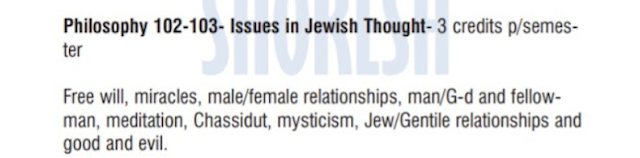
Most other BT schools do have introductory courses. Ohr Somayach has a course called "Introduction to Judaism." 


The followup course - Philosophy 102-103, Issues in Jewish Thought, is a part II of the introduction. Now that's more like an Ivy League school.


Ohr Somayach also offers an introduction to the halacha:


Many BT schools offer a class in the taryag mitzvos. This also qualifies as an introductory class. Aish Hatorah:


Yeshiva College:

Introduction to the Bible (BIB 1000)
Biblical Midrashim (BIB 1220) Introduction to the Aggadah

Orayta introduces students to halacha via five different classes


and to Jewish philosophy through a slew of classes including Introduction to Chazal:


Machon Shlomo had none of this. Do you want to say that introductory classes are goyish? (Maharetz Chajes didn't think so.) Calling yourself the Ivy League yeshiva is goyish.


Campus

Ivy League schools also have beautiful campuses with elegant buildings that are sometimes covered in ivy leaves, hence the ivy in the name Ivy League. Here's Harvard:


Here again is Machon Shlomo:


Compare to Aish HaTorah:


Now that looks more like an Ivy League school.

I would say the last place I'd describe as an Ivy League yeshiva is Machon Shlomo. 

So What Do They Mean?

By Ivy League, do they simply meant elite? Well, what's elite about it? The learning wasn't on a higher level. (I attended other places afterward.) The staff wasn't more elite than any other place. There have been all kinds of prestigious staff at the various BT schools. Many of them are or have been run by talmidei chocham of note. Ohr Somayach in Israel had Rav Dov Schwartzman, z’l, the son-in-law of Rav Aaron Kotler, z'l, Rav Schwartzman founded and led the Talmudical Yeshiva of Philadelphia together with Rabbi Shmuel Kamenetzky and was known as a Talmudic genius. Ohr Somayach also had Rav Aharon Feldman, who is now on the Moetzes Gedolei Torah of the Agudah and is the author of several books such as The Juggler and the King, a presentation of commentary from the Vilna Gaon on several aggadatos. Ohr Somayach also had Rav Nachman Bullman, translator of numerous books including Book of Our Heritage, Jew and His Home and Rite and Reason and rabbi of several Jewish communities. It also had Rabbi Uziel Milevsky, z’l who was the Chief Rabbi of Mexico and author of the two volume Ner Uziel of commentary on Chumash. In the summers, Rav Yisroel Reisman, the Rosh Yeshiva of Torah V’Daas and the maggid shiur of the legendary Nach shiuruim serves on the staff at Ohr Somayach. Aish HaTorah has had a whole slew of scholars including Rav Chaim Malinowitz z’l, who was the chief editor for the Artscroll Gemara and Rav Yitzchak Berkovits, who is the mara d’asra of Jerusalem’s Sanhedria Murhevet neighborhood and a Rosh Kollel. Ohr Somayach in Monsey had Rav Yisroel Simcha Schorr, the son of the gaon Rav Gedaliah Schorr z’l and a general editor of the Artscroll Gemara. D’var Yerushalayim had Rav Aryeh Carmel, z’l, the author of the five volume Strive for Truth and the classic Aiding Talmud Study. They have also Rav Boruch Horowitz who was a translator of Rav Hirsch's Horeb and a scholar in his own right and Rav Yoel Schwartz, who is the author of 200 books. Yeshiva University has world class scholars like Rav Hershel Schachter and Rav Dovid Bleich. Machon Shlomo has no advantage on the other BT schools in terms of prestige of faculty. To my knowledge, nobody on their staff has written any book or produced a substantial lecture series. Actually, I'd say that their staff was inferior to most of them. 

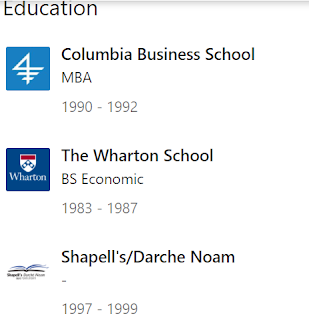
So what do they mean by Ivy League? Do they mean top students, "the best and the brightest" as their website currently phrases it? MS pursues guys from elite schools. Does it get them? It gets a few. There's a myth that they are running some kind of Cal. Tech graduate program in physics. The reality is not like that. There's usually an Ivy League or Ivy-equivalent (Chicago, Stanford, Berkeley) guy or two, sometimes three. Other BT schools also have such students. I know of a UC Berkeley undergraduate and law graduate who went to Aish HaTorah, a U. Chicago grad. who went to Shapells, a Harvard grad. who went to Shapells, a Penn and Columbia graduate who went to Shapells, a Columbia guy who went to Kol Yaakov, a Yale guy who went to Kol Yaakov, a Haverford graduate who went to Kol Yaakov, a Michigan graduate who went to Kol Yaakov, a University of Toronto PhD graduate who went to Ohr Somayach. And I know a guy who taught himself Hebrew and Yiddish in a short time who didn't go to college at all. He went to the BT program at Shar Yashuv. Here's the Penn. Wharton, Columbia guy who went to Shapell's. 


Here's a Harvard guy who went to Shapell's: (from Arutz Sheva)


Here’s the graduate of Shapell’s who went on to get a PhD from Harvard University.

So before moving to Boston to pursue further graduate studies, he and Yael spent a year at the David Shapell College of Jewish Studies/Yeshiva Darche Noam in Jerusalem. “That year in Israel really accelerated my knowledge,” Aldrich said. “We both studied text full time. We came back to Boston fully observant.
Aldrich received a Ph.D. in Government from Harvard and his wife received an M.B.A. and an M.A. in Jewish Community Studies, both from Brandeis University. ( https://cssh.northeastern.edu/jewishstudies/faculty-profile-daniel-aldrich/)

Here's a Harvard and Columbia graduate who went to Ohr Somayach:

Harry Rothenberg, Born and Raised: Philadelphia, Pennsylvania
Columbia University, BA: 1988, Harvard Law School, JD Magna Cum Laude: 1993
Yeshivat Ohr Somayach Jerusalem: 3 years (https://ohr.edu/articles/harry.html)

Here's another Harvard guy who went to Ohr Somayach:

"The program provided me with an introduction to Judaism that challenged and stimulated with its willingness to address fundamental questions and to examine the limits of belief." Nicholas Retter, BA, Harvard University (https://ohr.edu/1595)
Here's a Yale graduate who went to Ohr Somayach:
Rabbi Jeremy Kagan grew up in Hawaii and attended Yale University, where he received a B.A. in Philosophy. While traveling in Israel during college he began his Torah studies, going on to learn in Ohr Sameach, Meshech Chochma, and Heichal HaTorah B’Tzion. (https://midreshettehillah.com/great-school/meet-the-directors/)

All the schools have guys like this -- not that it's the most important thing in the world. ("I would rather be governed by the first 2000 people in the Boston telephone directory than by the 2000 people on the faculty of Harvard University." William F. Buckley) But it impresses people. People think that every Machon Shlomo guy is from one of these places, but most are not. They nearly all are college students or graduates and usually from respectable schools -- Rutgers, Wisconsin, Purdue, Union College, Cooper Union for example. Those are fine places but not Ivy League or Ivy equivalent. (Again, not that it's so important, but that's what MS is advertising.) Smart hard-working people go to such schools. But most American Jewish youth go to places like that. Machon Shlomo is not distinguished in that way.

So what did they mean when the told us at Moodus that Machon Shlomo was the best yeshiva, the Ivy League yeshiva for BTs? What about it is Ivy League? Is it just a marketing ploy? Yes, I think that's mostly what it was.

I believe it was also a reflection of the way the two founders saw themselves, as elite, the owners of the only viable approach to kiruv. As a former student described it:
That was one of the truly cultish things about machon shlomo- the daily reinforcement of the idea that they had the patented ‘correct’ view of judaism and no one, not artscroll, not the chassidim, no one really ‘got it’ but them.”
They believed that had the best program design, which as you see here, was a very simple design: Gemara iyun and Chumash with Rashi and no trips, guest speakers, warm get-togethers, or library. They called that focusing on the basics. They deemed all that other stuff that other schools do to be frivolous and time-wasting. Trips you can make on your own. Halacha you can read on your own (even though they didn't have a library). That's what they told us. Their idea was that they'd get top students to focus on the Gemara and Chumash text, and that, along with the hashkafas of the two founders, would make them the best school. 

If that's the approach be honest about it. The portrayal as being an Ivy League anything is not accurate. Other BT schools try to make themselves bigger and give as much content as they can. Machon Shlomo was the small school that made itself smaller but advertised itself as Ivy League. If Machon Shlomo was going to be different, it had to say that and shouldn't have described itself as it did and should have been clear that it was nothing like Moodus. 

In sum, the Torah Institute at Moodus (including its portrayal of Machon Shlomo) and Machon Shlomo itself were two different worlds back in the 1980s. They were two completely different institutions. In my opinion, this constituted deceptive recruiting. A former student described it in a way that matches much of what I found:
I will say that they have a 2 week summer program where the head rabbis come to the US and do a little road show, complete with BBQ's and science and torah lectures mixed in. The atmosphere is very laid back and the kiruv part gets ratcheted up by the end. You get tefillin and learn about tzitis, etc. You get Kelemen style lectures that are supposed to put aside your doubts. The rabbis are nice and smart and credible. You figure, it can't be all that bad.The yeshiva focuses on getting as many doctors, lawyers, scientists, mba's as possible to the yeshiva. The strategy is: get these guys whipped into shape in 2 years (they get you to agree to 1 year, then make you feel like a loser if you don't keep going) then married and off into the world. 
This is all quite manipulative. If you watch Steve Hassan's description of his indoctrination into the Unification Church (aka Moonies), it's similar. Some flirtatious Japanese girls invited him to a party. That led to an invitation to a weekend retreat on a remote estate where there was lots of sports and barbecues and some indoctrination that felt weird, but the bus wasn't leaving for a few days so he was stuck. Credibility for the indoctrination was helped along by the presence of people from fancy colleges (who as it turns out are just as susceptible to being indoctrinated into cults as anyone else) and gradually the indoctrination took hold as they manipulated his idealism in an environment of isolation and control. As Steve describes it, nobody joins a cult voluntarily. They are tricked. They don't realize what's happening to them. 

Post script: The Moodus camp is not used anymore. Rav Schwab was niftar, and Machon Shlomo isn't exactly the same as it was then but it's mostly the same. They still don't teach Hebrew, Mishnah, mitzvos, history, or Chassidus, and the halacha shiur is only 1 hour a week (still inadequate for beginners). I hear that it's not an overview; it's only about tefillah. Their philosophy of focusing on "the basics," hasn't changed. They use the phrase on the website, even though they don't teach the basics, they just study Chumash with Rashi and call that basic. The Gemara rebbes do talk to students now, and they go on one trip a year, most years that is. Har Nof grew from being a construction site to being a normal community. There also is a small library. It's a junk room really, with broken schtenders and used Gemaras clogging it up. But they have a few books. They give a two week introduction to the Gemara now before opening on page 2. Also, the schedule is available online, so you know before you commit to going there what classes are available. It's mostly accurate. However, the website contains what I deem to be deceptive recruiting because it still refers to the place as "The Ivy League yeshiva" for the "best and brightest." 


See, they are making the claim even though, as I have tried to explain, it's not accurate, not even close.

In sum, Moodus was an act of deceptive recruiting to an alarming degree.